 Adaptive core
Adaptive agents
Agents that turn histories and outcomes into evidence-backed proposals for better memory, context, skills, and workflows.
Agents that learn from every outcome—and never make a change you can't see, undo, or measure.
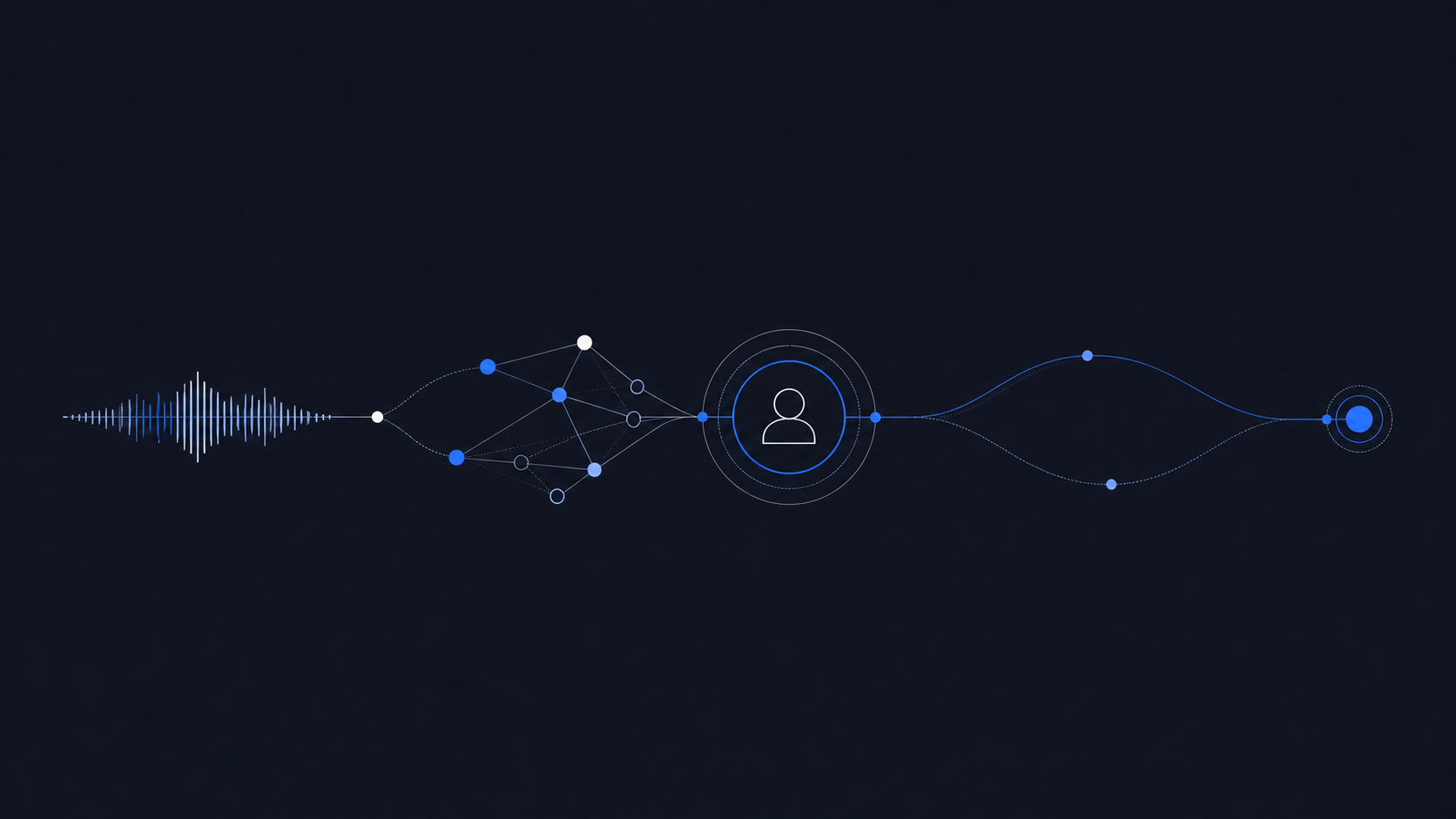
Products and solutions that connect real-world workflows, operational knowledge, and measurable outcomes—then keep improving under explicit human control.
Memory, context, tools, policies, and operational state work as one connected system—not isolated AI features.
Agents that turn histories and outcomes into evidence-backed proposals for better memory, context, skills, and workflows.
Knowledge graphs, vector recall, and live data assembled into exactly what the current task needs.
Low-latency conversations embedded in business workflows, with relevant history available as the call unfolds.
Pseudonymization, selective erasure, local-first storage, deployment choice, and an auditable control surface.
Relationships from a knowledge graph, semantic matches from vector recall, and live operational signals become one compact, provenance-aware context block.
Relationships, current truth, and where each fact came from.
Semantically relevant evidence across large knowledge estates.
What is happening now across workflows and business systems.
Budget-aware assembly: full, summarized, or omitted by priority.
“What does this customer need next—and why?”
Semantic evidence and graph-connected facts are assembled together, ranked for this moment, and kept within a defined context budget.
Relevant history and live business context arrive inside the conversation—fast enough to act, confirm, or hand off without breaking the flow.
“Could I move my appointment to a morning slot?”
“Yes. I found your preferred clinic and an opening tomorrow at 9:30.”
Work becomes history. History becomes evidence. Evidence becomes a proposed change. Every accepted change remains recorded, reversible, and re-measured.
Four of the last eight runs failed at the same attachment step. The proposed change cites each run by hash and cannot execute its own advice.
Deployment boundary, model provider, retention, erasure, and approval policy remain explicit choices—not hidden assumptions.
Sensitive identity and quasi-identifiers can be removed or pseudonymized before context reaches a model, while the operational system keeps the authorized mapping.
Direct identity and location are removed. Task-relevant preference remains available.
Named approvals, written reasons, replayable execution, stored inverses, and regression checks make accountability part of the runtime.
Inspect the code. Extend it. Self-host it. Open-source foundations for governed adaptation, embedded voice, and deterministic agent work.
Governed adaptive-agent infrastructure: memory, context graph, execution history, and a human-gated improvement loop.
View on GitHubA self-hosted, native-Rust runtime for real-time voice agents, with in-process SIP/RTP and provider choice.
View on GitHubDeterministic tools for large files, binary formats, and strict transformations that agents cannot afford to guess.
View on GitHubSpecialized experiences preserve the workflows, terminology, handoffs, and trust requirements of each operating environment.
Bring the problem, workflow, or product idea. Shape it into an accountable system ready for the real world.